All Articles

Blog

Regulatory Update: The New Local Plan System For 2026

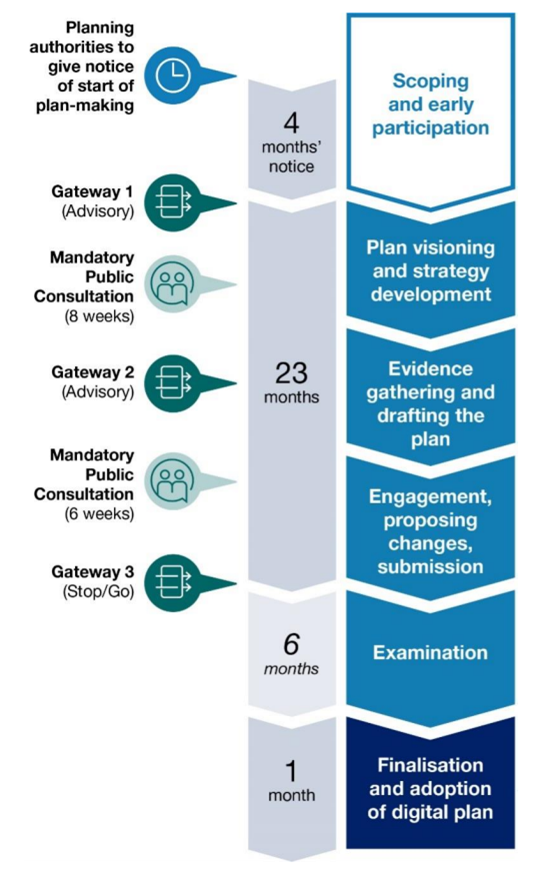
Last week the Government published further information on the new local plan system which will come into effect from early 2026. The new system introduces a 30-month preparation process, three formal “gateways”, and new digital-first requirements for how plans and evidence are to be produced and presented.

The three “gateways” are:

  1. Scoping and strategic priorities
  2. Draft plan
  3. Readiness for examination

The aim is to streamline plan-making across England at a time when fewer than one third of local planning authorities (LPAs) have an up-to-date local plan.

Throughout 2026 both plan-making systems will run in parallel, with LPAs either proceeding with a well-advanced emerging plan and submitting it for examination under the legacy system before 2026 year-end or transitioning to the new one by the same date.

The long-standing Duty to Cooperate will also be removed for plans examined under either system, in an attempt to support faster adoption of plans that are better aligned with wider regulatory reform cycles.

For rural areas, this will mean working to tighter timescales, transferring emerging plan progress to-date across to the new system, all whilst balancing increasing housing and employment targets, as well as existing landscape, environmental and infrastructure considerations.

The result = a managed overhaul in the short term to place plan-making on a streamlined and more stable footing in the long term.

As a private planning consultancy specialising in rural environments, we are already reviewing the new guidance so that we can support landowners and rural businesses ahead of these upcoming changes, from early scoping of strategic priorities and site promotion, to shorter-term housing delivery applications and plan consultation representations. If you’d like to discuss what the new system might mean for your area or land interests, please get in touch with our Planning Team.

 All Articles

Blog

New Town Boom, Old Town Gloom: A Strategic Planning Divide

Spatial planning is demonstrating itself as an important tool of the current Labour Government’s strategy, with various National Policy reforms and initiatives demonstrating their increased awareness of how contemporary issues are transposed through spatial channels, all the way to the level of our neighbourhoods.


An example of this is the establishment of the New Towns Taskforce, demonstrating a level of Governmental confidence in large-scale development which we have not seen since the post-war era. Here we see the Government envisioning a need to mitigate for a noticeable hastening of urban problems through the development of 12 climate-resilient, sustainable and equitable new towns.


Whilst the mechanisms for achieving these outcomes are not yet fully realised, the prospect of the proposed development corporations adhering to the bold 40% affordable housing targets alongside achieving clear-cut placemaking principles is exciting, even if scarcely already demonstrated. The level of granularity and attention given to futureproofing placemaking practice in the taskforce’s Report to Government demonstrates a clear understanding of the interdependencies of urban life – importantly for us, showcasing clearly how planners, designers and architects can fashion positive social, economic and environmental outcomes.


The New Towns scheme proves to be a window into Labour’s seeming intention to hold new developments to the highest design standards, preparing the next generation of housing-stock to elicit holistic benefits far greater than just housing. Projects such as The Pheonix in Lewes and Forest City 1 in Cambridgeshire appear to exhibit many of these guiding design principles at their forefront. Seeing the addition of such granular spatial understanding at the local scale is refreshing, considerably so when situated next to much of the contestation experienced surrounding current housing developments in the United Kingdom. We await to see the takeaways from the further information scheduled to be published in Spring 2026 – it is with a hopeful mind that this positive trajectory is sustained.


Nonetheless, whilst this initiative has the potential to prove itself as a success in delivering sustainable and equitable neighbourhoods across the country, the newly revamped ‘Pride in Place’ programme seems to have missed the mark in some capacities.


During a time of active discourse surrounding the establishment of new towns, existing neighbourhoods and town centres seem to have been overlooked. The Pride in Place programme provides a generous sum of money to areas which are experiencing both the highest deprivation levels and weakest social infrastructure, in order to enhance their public spaces, community assets and other spaces for communal engagement. However, a cash injection for such facilities may do little to appease the collective voices of dissensus, which have seen their neighbourhoods and towns regress through no fault of their own, let alone a lack of local pride.


Where there is such an onus placed on ‘getting it right’ with new towns, there seems to have been a fundamental misjudgement in aligning those principles to existing neighbourhoods, where considerations of how social atmosphere, knowledge transfer and capacity-building could, and deserve to be, thoughtfully implemented. The Pride in Place money pot seems to depict another symptomatic response to decades-long legacies of austerity and urban governance neglect in our communities. It presents change which does not provide the level of resources, knowledge for communities, and their local governments, to enact resilient change.


All in all, the seeds have been sown by this Government to display their understanding of urban issues and how we can mitigate them with forward-thinking planning. The work of the New Towns Taskforce displays the Government’s intentions to put these principles into the foundation of everyone’s lived experiences, although the remit is disproportionately focussed on new settlements. Unfortunately, the impact of top-down support for existing communities is not so apparent and looks set to continue to be speculative at best.

 All Articles

Blog

Government to Introduce New Measures to Overcome Obstructive Local Decisions on Housing Applications

The Government has announced forthcoming changes to the National Planning Policy Framework (NPPF) that will introduce a presumption in favour of new homes located near “well-connected” train stations, even on green belt land, provided proposals comply with yet to be defined criteria.


This headline grabbing ‘Default Yes’ policy aims to accelerate housing delivery around key transport hubs. It appeared in a joint statement from Housing Secretary Steve Reed, the Ministry of Housing, Communities and Local Government (MHCLG), and chancellor Rachel Reeves with other measures outlined including minimum density requirements to ensure efficient land use in these highly accessible areas with the aim of maximising opportunities for sustainable growth in housing, employment, and local business activity.


The Government says these planning reforms are intended to provide “greater certainty and strength for development around well-connected rail stations,” including tram stops. An updated, “pro-growth and rules-based” NPPF will be subject to public consultation later this year.


The second part of the statement also confirmed new oversight measures that would require local authorities in England to notify the government when they plan to reject housing schemes of more than 150 homes. The Housing Secretary would then decide whether to intervene and take over the decision. Particular scrutiny will be applied when planning committees propose to overturn the recommendations of planning officers. Additionally, applications called in by ministers will be fast-tracked through the removal of mandatory inquiry requirements.


Desperate times call for desperate measures for the Government when it comes to trying to get even remotely close to hitting the 1.5 million new homes target this parliament. Getting planning applications approved at the level required, against the will of local councils and communities, continues to be a challenge that no end of reforms to the system can overcome. Taking these decisions away from locally elected officials is controversial and may ultimately be seen as a step too far.

 All Articles

Blog

Planning and Infrastructure Bill

The Planning and Infrastructure Bill, introduced by Deputy Prime Minister Angela Rayner on 11 March, aims to accelerate housebuilding and essential infrastructure, positioning the UK as a clean energy superpower.

Alongside reforms to the National Planning Policy Framework (NPPF), which were published in December 2024, the bill forms part of the government’s Plan for Change to boost economic growth. Key reforms include:


  1. Planning Fees

Councils will set planning fees to cover costs, with funds reinvested to enhance decision-making efficiency. While there are concerns about increased costs for smaller developers, faster processing may ultimately benefit the industry by reducing delays.


Dr Victoria Hills, chief executive at the RTPI commented that “By deciding to invest planning fees into planning services, the government not only addresses a key request long advocated for by the RTPI, but demonstrates that it has listened to our repeated concerns about the chronic underfunding of the planning system and the resulting impact on day-to-day delivery.”


  1. Statutory Consultation

The government will streamline the statutory consultee process to focus on relevant parties, aiming to reduce delays while ensuring democratic involvement. Striking a balance between efficiency and inclusivity is crucial.


  1. Planning Committee Reforms

A national scheme will classify applications to determine which are handled by officers versus committees. This aims to expedite the approval process for smaller projects, though it’s vital to ensure local community concerns remain addressed.


  1. Nature Restoration Funds

Developers will contribute to a fund for large-scale environmental projects, addressing ecological issues more effectively than site-specific solutions. This approach holds promise for creating lasting positive environmental impacts that benefit both the development sector and the community.


  1. Compulsory Purchase Orders

The Bill sets out plans to reform the compulsory purchase order regime with the aim being that compensation paid to landowners is not excessive and the process of using directions to remove ‘hope value’ where justified in the public interest is sped-up. The British Property Federation commented, “The recent changes to Compulsory Purchase Orders in the Levelling Up and Regeneration Act 2023 haven’t really been tested yet, so we need to proceed cautiously with further changes and make sure we do it in a way which fairly balances needs of communities with rights of landowners and stimulates rather than inhibits development.”


  1. National Significant Infrastructure Projects (NSIPs)

The government plans to reform the NSIP process to expedite approvals for major infrastructure projects, particularly in energy, to enhance energy security. While local opposition remains a challenge, these reforms aim to balance urgent energy needs with local concerns.


  1. Incentivising Local Communities

The Bill proposes energy bill rebates for residents near new pylons to promote community acceptance of energy projects. This financial incentive encourages local support for clean energy initiatives, making communities stakeholders in the transition to cleaner energy. Proper implementation is essential to maximise benefits.


  1. Spatial Development Strategies

New spatial development strategies from regional mayors and local authorities aim to enhance regional planning by improving land use and infrastructure. While their effectiveness may still be uncertain, these strategies have the potential to promote cohesive and efficient planning, benefiting both developers and local communities.


Conclusion

The Planning and Infrastructure Bill aims to expedite planning and construction while balancing efficiency with community involvement. It focuses on enhancing housing, infrastructure, and clean energy, presenting opportunities for developers, local authorities, and communities. While the proposals seem beneficial, it’s crucial to ensure they don’t overlook local concerns or democratic processes. If implemented effectively, these reforms could significantly improve the planning landscape and promote housing, infrastructure, and environmental sustainability.


This latest stage of the government’s planning reforms has been met positively by the industry. However, it is vital that all of this is adequately resourced in the forthcoming spending review if it is to deliver transformational change in the planning system.


Published 17th March 2025
 All Articles

Blog

Planning Fee Increase – 1st April 2025

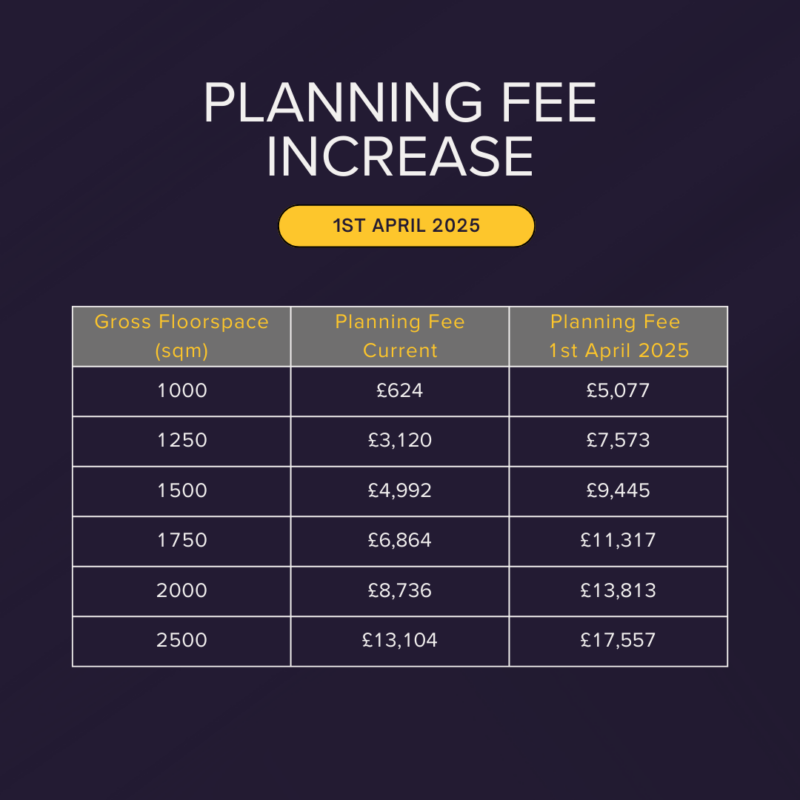
Planning application fees will rise steeply from 1st April in a bid to plug a major funding shortfall for local authority planning departments. Fees relating to Prior Approval and Prior Notification applications are one example, where the charge will double. The new fee for changing the use of agricultural buildings to residential will be £516 (100% increase), while the fee for building an agricultural structure under permitted development (PD) will rise to £240 (100% increase).


The base fee for new agricultural buildings over 1,000sqm will also increase from £624 to £5,077, with an additional £624 for every 75sqm or part of it thereafter (this part remains unchanged).

See the table for examples.

There will also be three fee tiers for applications to vary or remove planning conditions:


* £2,000 (583% increase) for major applications
* £86 (71% decrease) for household applications, and
* £586 (100% increase) for all other cases


If you have any upcoming projects that require planning permission, now is the time to act to try and beat the 1st April deadline. If you would like to discuss the submission of a planning application, please get in touch with our planning consultancy team.


Email: advice@wilsonwraight.co.uk
Tel: 01284 700727


Published 28th January 2025

 All Articles

Blog

2025 – A Big Year for the Planning System and Development Industry?

The updated National Planning Policy Framework, revised practice guidance, and upcoming reforms are expected to begin establishing the conditions needed within the planning system to address the various obstacles to development.


The government’s new requirement for certain local authorities to add a 20 per cent buffer to their five-year housing land supply figure from July 2026 puts councils under fresh pressure but gives landowners and developers a chance to look again at prospective sites.


The previous update of the NPPF, freed planning authorities with up-to-date local plans from the need to demonstrate a five-year housing land supply. It also cut the requirement to four years for those with advanced draft plans.


The Labour government, recognising the damage this was doing to the development industry and its potential to further exacerbate the housing crisis, have worked quickly to undo those measures.


The changes in the latest NPPF therefore represent a significant adjustment meaning that if the annual housing requirement figure in a Local Authorities plan is 80 per cent or less than the local need figure calculated by the government’s revised standard methodology, they will have to add a new 20 per cent buffer to their five-year housing land supply figure from the beginning of July 2026. This effectively equates to a 6-year housing land supply.


Developers and promoters will be looking closely at which Local Authorities will soon be in this position and will be considering whether to take forward planning applications and appeals which last year would have been considered too risky.


Head of Planning Dan Hewett comments that, “Now is the time to reassess whether you have land with development potential, as there may be opportunities to secure allocations or planning permissions in the coming year or so on sites which were previously considered to have much longer-term prospects.”


If you would like to discuss the potential of your land or buildings in light of these changes, please get in touch with our planning consultancy team.


e: advice@wilsonwraight.co.uk
t: 01284 700727


Published 7th January 2025

 All Articles

Blog

Planning Team Ends Year on a High

Our Planning Team ends the year with planning application and appeal successes this week including the following:


*Planning Application Granted: Change of use of a commercial building used for packaging dog food to a children’s nursery.


*Planning Appeal Allowed: Change of use of land to B8 storage for self-storage containers.


Head of Planning Dan Hewett comments that the appeal decision is particularly pleasing due to the poorly informed nature of the reasons for refusal which included a misinterpretation of the rationale behind the designation of ‘Quiet Lanes’. The Inspector came down firmly on our interpretation that they are designed to enable users to enjoy country lanes in greater safety and encourage drivers to respect more vulnerable road users, rather than being used as a tool to limit or significantly calm traffic. Unfortunately, the LPA saw fit to refuse and then defend their decision to refuse a small-scale diversification project in a rural area, which will be a cost picked up by the taxpayer.


Please contact our planning consultancy team to discuss any planning needs you may have.


advice@wilsonwraight.co.uk

t: 01284 700727


Published 20th December 2024

 All Articles

Blog

National Planning Policy Framework (NPPF) Published

On 12th December 2024, The Ministry of Housing, Communities and Local Government published the much anticipated latest version of the National Planning Policy Framework (NPPF). This carries forward many of the changes proposed in the consultation version. For decision taking, the NPPF applies from today. In respect of local plan making, transitional arrangement have been put in place.


The key points of note in the new document are:


• The Standard Method to assess the level of housing need increases by circa 20% in England in order to respond to areas with poor housing affordability. The result is a total of 371,541 new homes are required nationally per annum.

• A six-year housing land supply requirement comes into effect for local authorities with a local plan housing requirement over five years old, where it is 80% or less of the level set by the new Standard Method;

• The introduction of Grey Belt and clarification on circumstances whereby Green Belt land can be released for development;

• The level of affordable housing required on housing sites removed from the Grey/Green Belt;

• The approach to the sequential test for assessing Flood Risk; and

• The transition arrangements for the application of the new NPPF for decision taking and plan making.

• In respect of design, the word ‘beautiful’ has been removed from the new version, the goal of planning policy remains to ensure ‘high quality’ design.

• In respect of renewable energy and infrastructure, the new version brings to an end the effective ban on onshore wind generation in England.


Relevant parts of the Planning Practice Guidance (PPG) have also been updated, including housing and economic needs assessment, housing supply/delivery and plan making.
The Government has also confirmed the introduction of the Planning and Infrastructure Bill next year, which will further reform the planning system, including a national scheme of delegation, which may effectively give more powers to professional planning officers and standardise the scope of elected planning committees. It is hoped that this will remove the delays and unpredictability which plagues the current planning committee system.


The updated NPPF is considered by the industry to be a positive step towards trying to achieve the government’s growth targets. It certainly sends a clear message to Local Planning Authorities that there is a need to get their Local Plans in place in order to have any chance of meeting the new housing targets or face continual waves of speculative applications.


It is clear that a wide range of sites will be required to enable the delivery of the Government’s ambitious housing targets. If you have any questions about the implications of the new NPPF on your land or buildings, please get in touch with our planning consultancy team.


e: advice@wilsonwraight.co.uk
t: 01284 700727


Published 13th December 2024

 All Articles

Blog

The King’s Speech: Implications for Devolution and the Planning System

A new Planning and Infrastructure Bill to accelerate the delivery of high-quality infrastructure and housing and a bill devolving powers to elected mayors and combined authorities were announced in the King’s Speech.


The Devolution Bill for England would establish an “ambitious standardised” framework to expedite the process of transferring powers. A document published alongside the speech states that the new bill will establish a “simpler process” for setting up new combined and combined county authorities and moving towards “advanced mayoral settlements.” Its aim is to facilitate the quick provision of devolved powers to more areas. However, there is currently very little information available about what the new framework will look like.


What does this mean for planning?


The proposed process aims to enhance decision-making by granting additional authority over strategic planning, local transport networks, and skills and employment support. It will also facilitate the implementation of local growth plans that generate economic benefits for communities.


We are looking forward to hearing more about how Labour’s plan to devolve power will be put into action. However, this will not be a quick process, in the meantime, we can expect further details on short-term changes to policy by the end of July, whereby revisions to the NPPF can be expected to be published for a period of consultation.


Please do not hesitate to contact our planning team for more information regarding the potential changes.

advice@wilsonwraight.co.uk
01284 700727

Published 18th July 2024

 All Articles

Blog

Planning Update: Onshore Wind Farms

In our previous blog post, we delved into the details of the Labour Party Manifesto 2024, focusing on its implications for planning reform. Point 5 of our 16-point summary highlighted the Governments urgent need to revise the National Planning Policy Framework (NPPF). This revision includes specific changes related to onshore wind farms.


During their campaign Labour stated that “to deliver our clean power mission, Labour will work with the private sector to double onshore wind, triple solar power, and quadruple offshore wind by 2030”


During the Conservative Government, onshore wind farms were effectively banned via footnotes 57 and 58 of the National Planning Policy Framework (NPPF). These footnotes specifically targeted onshore wind farms, imposing stringent requirements for local support and making it extremely difficult to build turbines unless the areas were designated within local plans or development orders for this purpose.


The new Government has already confirmed in a ‘Policy Statement on Onshore Wind’ issued on the 8th July 2024 that footnotes 57 and 58 in the NPPF no longer apply. This means that onshore wind projects will now be considered on an equal basis with all other types of infrastructure. This change will be officially confirmed to parliament when it resumes sitting on the 18th July and will be reflected in the forthcoming NPPF update. Labour also announced that it will take an additional step by considering whether to classify large wind farms as nationally significant infrastructure projects to support quick determination.


These changes will lead to more opportunities for the development of renewable energy projects. If you would like to discuss the implications of these changes, please feel free to reach out to one of our expert planning consultants.


advice@wilsonwraight.co.uk

Published 16th July 2024