Blog
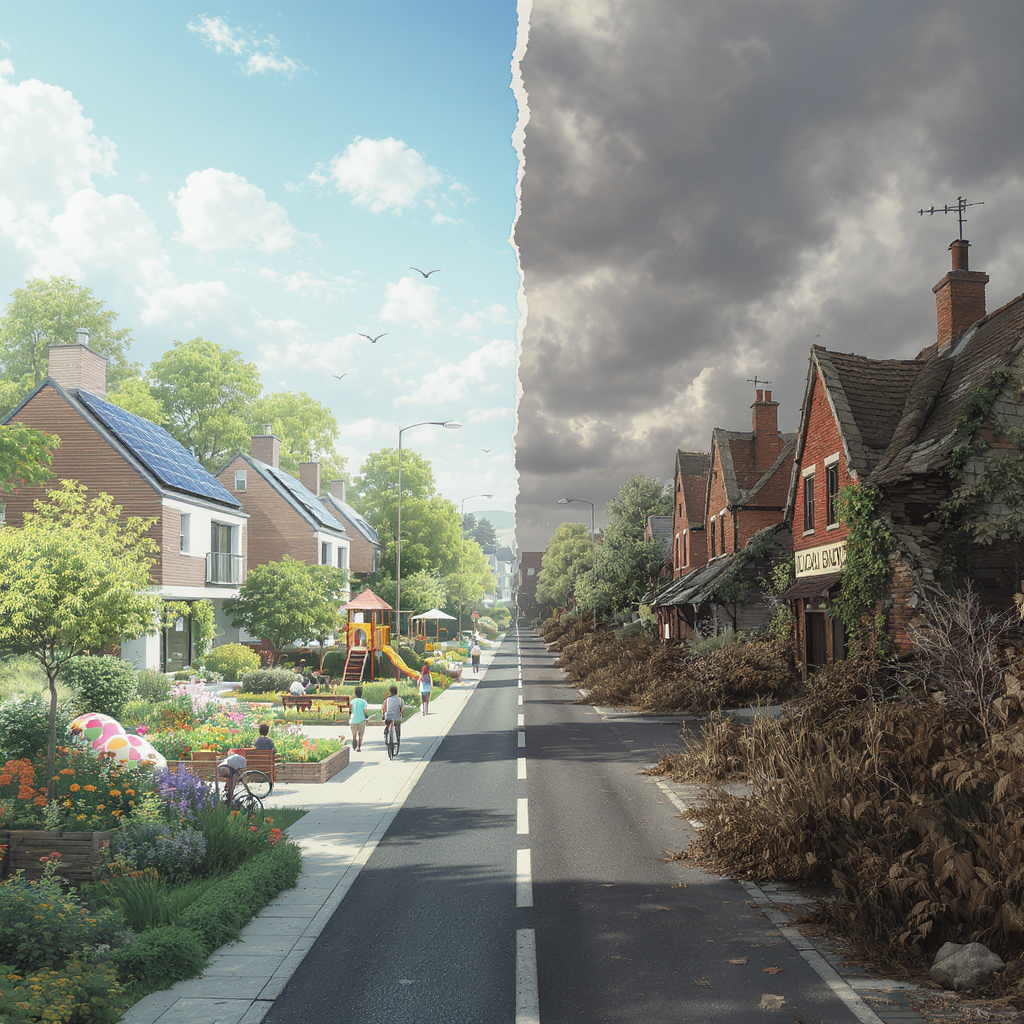
New Town Boom, Old Town Gloom: A Strategic Planning Divide
Spatial planning is demonstrating itself as an important tool of the current Labour Government’s strategy, with various National Policy reforms and initiatives demonstrating their increased awareness of how contemporary issues are transposed through spatial channels, all the way to the level of our neighbourhoods.
An example of this is the establishment of the New Towns Taskforce, demonstrating a level of Governmental confidence in large-scale development which we have not seen since the post-war era. Here we see the Government envisioning a need to mitigate for a noticeable hastening of urban problems through the development of 12 climate-resilient, sustainable and equitable new towns.
Whilst the mechanisms for achieving these outcomes are not yet fully realised, the prospect of the proposed development corporations adhering to the bold 40% affordable housing targets alongside achieving clear-cut placemaking principles is exciting, even if scarcely already demonstrated. The level of granularity and attention given to futureproofing placemaking practice in the taskforce’s Report to Government demonstrates a clear understanding of the interdependencies of urban life – importantly for us, showcasing clearly how planners, designers and architects can fashion positive social, economic and environmental outcomes.
The New Towns scheme proves to be a window into Labour’s seeming intention to hold new developments to the highest design standards, preparing the next generation of housing-stock to elicit holistic benefits far greater than just housing. Projects such as The Pheonix in Lewes and Forest City 1 in Cambridgeshire appear to exhibit many of these guiding design principles at their forefront. Seeing the addition of such granular spatial understanding at the local scale is refreshing, considerably so when situated next to much of the contestation experienced surrounding current housing developments in the United Kingdom. We await to see the takeaways from the further information scheduled to be published in Spring 2026 – it is with a hopeful mind that this positive trajectory is sustained.
Nonetheless, whilst this initiative has the potential to prove itself as a success in delivering sustainable and equitable neighbourhoods across the country, the newly revamped ‘Pride in Place’ programme seems to have missed the mark in some capacities.
During a time of active discourse surrounding the establishment of new towns, existing neighbourhoods and town centres seem to have been overlooked. The Pride in Place programme provides a generous sum of money to areas which are experiencing both the highest deprivation levels and weakest social infrastructure, in order to enhance their public spaces, community assets and other spaces for communal engagement. However, a cash injection for such facilities may do little to appease the collective voices of dissensus, which have seen their neighbourhoods and towns regress through no fault of their own, let alone a lack of local pride.
Where there is such an onus placed on ‘getting it right’ with new towns, there seems to have been a fundamental misjudgement in aligning those principles to existing neighbourhoods, where considerations of how social atmosphere, knowledge transfer and capacity-building could, and deserve to be, thoughtfully implemented. The Pride in Place money pot seems to depict another symptomatic response to decades-long legacies of austerity and urban governance neglect in our communities. It presents change which does not provide the level of resources, knowledge for communities, and their local governments, to enact resilient change.
All in all, the seeds have been sown by this Government to display their understanding of urban issues and how we can mitigate them with forward-thinking planning. The work of the New Towns Taskforce displays the Government’s intentions to put these principles into the foundation of everyone’s lived experiences, although the remit is disproportionately focussed on new settlements. Unfortunately, the impact of top-down support for existing communities is not so apparent and looks set to continue to be speculative at best.